Sport and exercise are closely connected, but they are not the same thing.
That distinction matters.
Many of the attitudes we associate with sport have gradually found their way into gyms and exercise programmes:
- Push yourself to exhaustion.
- Ignore discomfort.
- Move faster.
- Lift heavier.
- Leave everything on the floor.
- Accept soreness and injury as part of the process.
For an athlete attempting to win a competition, break a record or beat an opponent, taking calculated risks may sometimes be necessary.
But most people are not training to win a medal.
They are exercising because they want to feel better, remain independent, manage pain, recover from an injury, improve their health or continue doing the things they enjoy for decades.
Those goals require a different mindset.
Exercise Is Not a Sport
Sport is ultimately a competition.
It may involve competing against another person, another team, a previous performance or a fixed result. Success often requires speed, aggression, momentum, risk and a willingness to push beyond normal limits.
Exercise does not have to work that way.
Exercise is a tool used to create a specific adaptation in the body. That might mean improving strength, increasing muscle mass, building cardiovascular fitness, restoring confidence after an injury or increasing someone’s capacity to tolerate everyday life.
The aim is not simply to perform more work.
The aim is to apply the right amount of challenge, in the right place, at the right time.
However, because exercise and sport are so closely associated, many people assume a good workout should resemble a sporting event.
They throw weights using momentum. They rely on inertia to move loads they cannot fully control. They rush repetitions, chase fatigue and push through warning signs because stopping feels like failure.
The workout becomes something to survive rather than something designed to improve them.
Exercise Can Assist Sport — But It Isn’t the Sport
None of this is to say that exercise cannot improve sporting performance.
It absolutely can.
But if you want to get better at playing tennis, you need to play tennis. If you want to become a better golfer, you need to practise golf. If you want to become a better rugby player, you need to practise rugby.
The best way to develop the skills required for a sport is to practise the sport itself.
The gym has a different job.
Exercise can help build the physical qualities that support your sport — strength, muscular capacity, cardiovascular fitness and the ability to tolerate repeated physical demands.
Perhaps more importantly, it can help make you more robust for the things we cannot control once you step onto the pitch, court or course.
Because sport is unpredictable.
An opponent tackles you. You land awkwardly. Someone collides with you. You have to accelerate, decelerate or change direction without warning.
External forces are applied to your body at angles, speeds and magnitudes that cannot always be predicted.
Exercise gives us an opportunity to prepare the body for that chaos without needing to recreate the chaos itself.
That distinction is important.
We don’t necessarily need to make an exercise more “sport-specific” by making it unstable, explosive or unpredictable.
Let the sport provide the unpredictability.
Let practice develop the skill.
And use exercise to build a stronger, more capable and more robust body that is better prepared to deal with the consequences.
That, to me, is one of the most useful relationships between exercise and sport:
Practise your sport to get better at your sport. Use exercise to build a body capable of surviving and supporting it.
Soreness Is Not the Same as Progress
There is often a sense of pride attached to being unable to walk properly after training.
People judge the quality of a session by how much they sweat, how exhausted they feel or how sore they are the following morning.
But soreness is not a reliable measure of whether an exercise was appropriate or effective.
It mainly tells us that the body experienced something unfamiliar or sufficiently disruptive.
A productive training session may create some temporary fatigue or soreness, particularly when someone begins a new programme. But neither should be the main objective.
The goal is to create enough stimulus to encourage adaptation without unnecessarily exceeding the person’s ability to recover.
More discomfort does not automatically produce more benefit.
More exercise is not always better exercise.
And an injury is certainly not proof that someone trained hard enough.
I’ve Stepped on a Few Landmines Myself
I should probably point out that I’m not writing this as someone who has spent his life avoiding hard training.
Quite the opposite.
I played rugby for years, and I’ve got the injury history to show for it: two MCL tears, a broken radius twice, shoulder surgery, and more muscle strains and tears than I care to remember.
So, anecdotally, I probably understand the distinction between training for performance and training for health better than most.
When I was playing rugby, there were times when the calculation was different.
Performance mattered. Getting back on the pitch mattered. Sometimes you accepted risks because playing the sport was the goal.
And, like plenty of young athletes, I certainly wasn’t thinking about what my knees, shoulder or the rest of my body might feel like when I was approaching 40.
I am now.
None of this means I regret playing rugby or think sport is bad for you. Far from it. Sport gave me an enormous amount.
But my own injury history has probably made me more interested in the question:
How do we get all the benefits of challenging our bodies without taking risks that serve absolutely no purpose?
If you’re playing rugby and someone tackles you, there’s only so much control you have over the forces involved.
If you’re doing a leg extension in a gym, we have considerably more control.
That distinction matters.
We shouldn’t introduce sporting levels of chaos and risk into exercise when there is no sporting outcome that requires it.
And that brings me to the landmines.
The Landmines We Cannot See
One of the biggest challenges in personal training is that every person arrives with a body containing things we cannot immediately see.
I sometimes think of these as landmines.
A landmine might be a degenerative joint change that has not yet caused symptoms. It could be a tendon whose capacity has gradually reduced, a previous injury, an undiagnosed medical condition or simply a movement or position that becomes problematic under sufficient load.
There are also things outside the gym that affect what someone can tolerate: stress, sleep, medication, illness and everything else going on in their life.
Someone may look healthy, move well and report no pain while one of these issues is quietly developing in the background.
That doesn’t mean we should become frightened of exercise.
It means exercise should be applied thoughtfully.
If we treat every session like a competitive event, increasing intensity for its own sake and repeatedly pushing people beyond control, we make it more likely that eventually we’ll step on one of those landmines.
And sometimes you only discover the landmine once you’ve stepped on it.
What Twelve Years of Training Lizzie Has Taught Me
I’ve worked with Lizzie for almost twelve years.
During that time, she has trained consistently and made enormous progress.
More recently, she began experiencing symptoms relating to her hip and is now preparing for hip replacement surgery.
The degenerative changes in her hip may have started before we ever worked together.
They may have developed gradually during the years we trained.
We simply cannot know with certainty.
What we do know is that there were no obvious warning signs until roughly twelve to eighteen months ago.
Had we known what was developing inside the joint, would we have changed some of the exercises, ranges, loads or methods we used?
Possibly.
But we didn’t know.
That experience has made me even more aware that every client may have unseen landmines within their body.
But this is where Lizzie’s story gets interesting.
“And I Took That Personally”
When it became clear that Lizzie would eventually need a hip replacement, there was a little bit of the Michael Jordan meme in me:
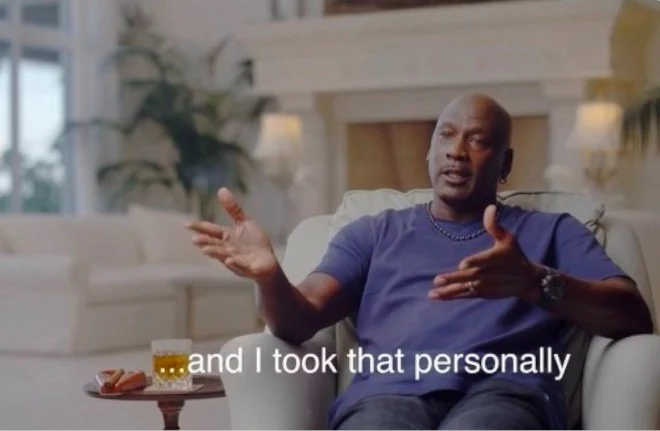
Not because needing surgery represented some kind of failure. Sometimes surgery is exactly the right intervention.
What I took personally was the idea that we should simply accept months of increasing pain, declining strength and reduced activity while she waited for the operation.
So we went to work.
We adjusted exercises. We changed ranges, loads and positions. We found ways to continue challenging her without unnecessarily aggravating the hip.
Rather than allowing her world to get smaller as surgery approached, we kept trying to expand what she was capable of doing.
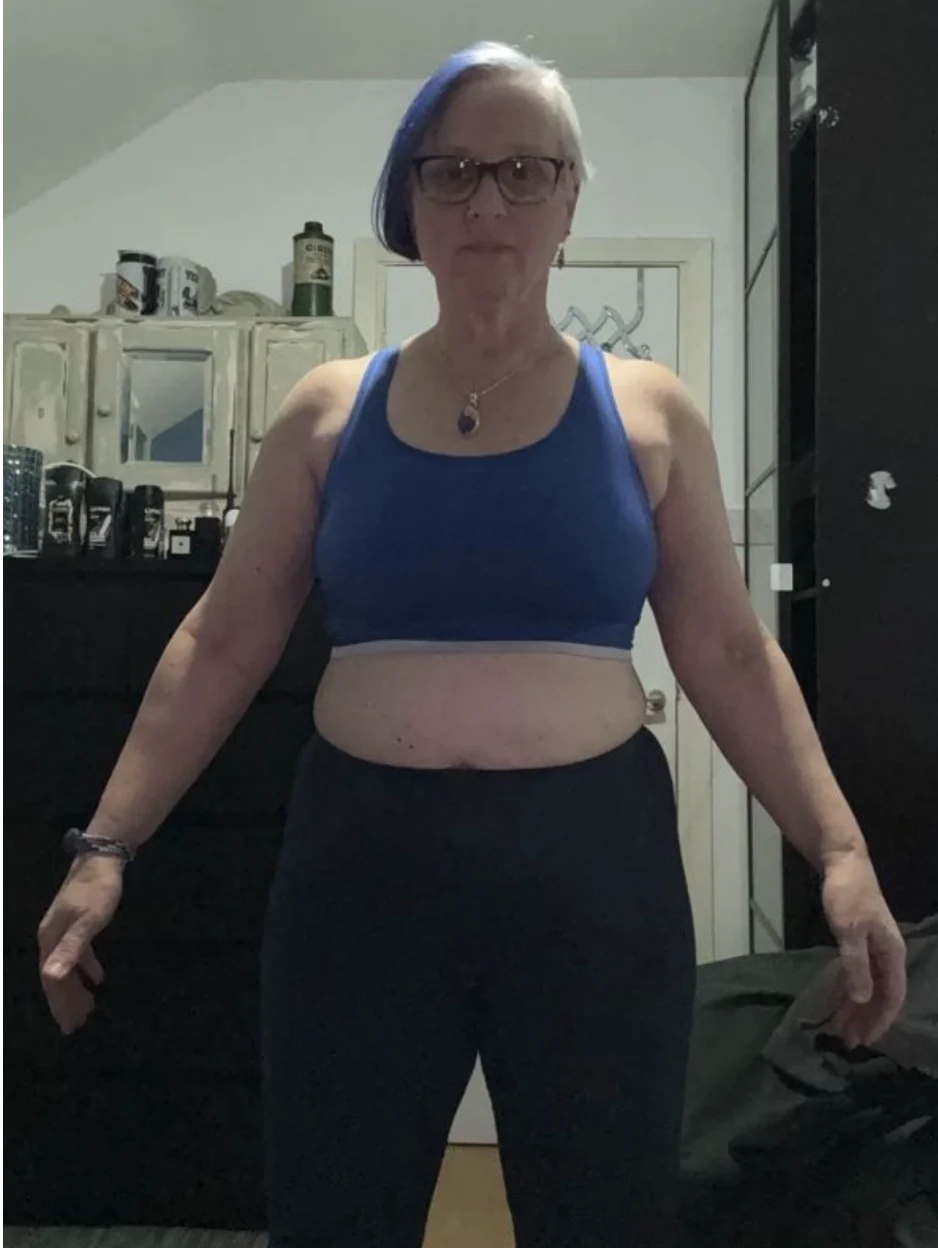
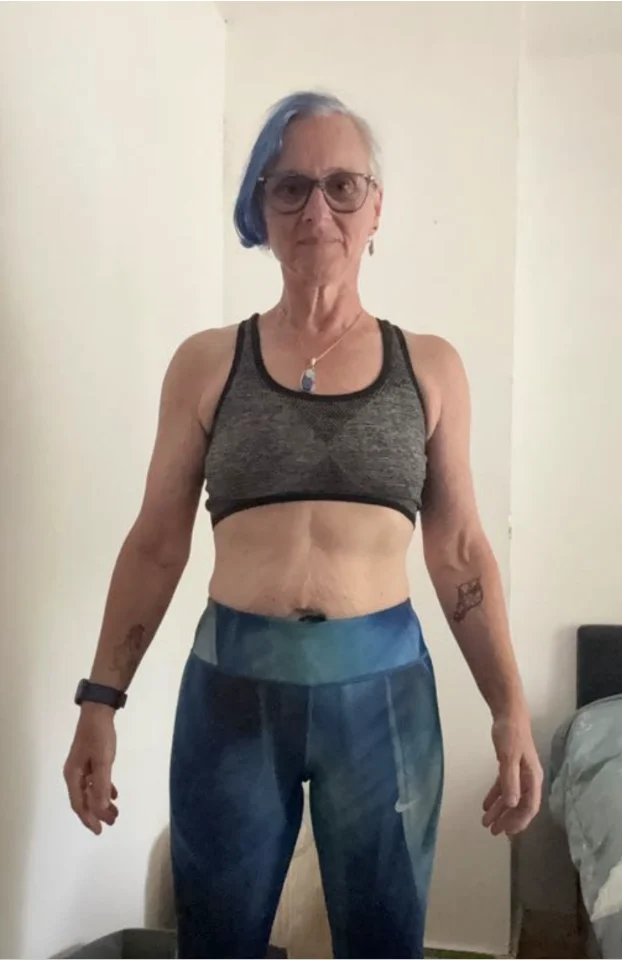
Lizzie before losing 25kg during her hip replacement prehab journey