One leg stronger than the other? One foot turns out more? One shoulder sits higher? Before you decide that your body is “imbalanced” and needs fixing, it’s worth understanding that human beings aren’t supposed to be perfectly symmetrical.
If you’ve spent any time in gyms, physiotherapy clinics or scrolling through fitness content online, you’ve probably heard some version of this:
“You’ve got a muscle imbalance.”
One shoulder might sit slightly higher than the other. Perhaps one leg is stronger. One hip moves differently, or one foot turns out more when you squat.
The implication is usually that something is wrong — and that the difference needs correcting.
But does it?
At NG Health & Fitness, we work with people with a huge range of bodies, injury histories and joint structures. Many come to us following physiotherapy, surgery or years of persistent joint problems.
One of the most important things we can help them understand is this:
Different doesn’t automatically mean dysfunctional.
What is a muscle imbalance?
A muscle imbalance generally describes a difference in strength, movement or muscular development between different muscles or between the left and right sides of your body.
And those differences absolutely exist.
The mistake is assuming that their existence automatically represents a problem.
Think about how you actually live.
You probably write with the same hand each day. You kick a ball with a preferred foot. You carry bags on a preferred side. You lead with a particular leg when climbing stairs.
Even people who describe themselves as ambidextrous don’t divide every movement throughout their lives perfectly between both sides.
Your environment isn’t symmetrical.
Your behaviour isn’t symmetrical.
So why would we expect your body to be?
Your body adapts to what you ask it to do
The human body is remarkably adaptable.
When we’re repeatedly exposed to a particular task, our bodies change in response to the demands being placed upon them.
A fantastic historical example is the skeleton of an archer.
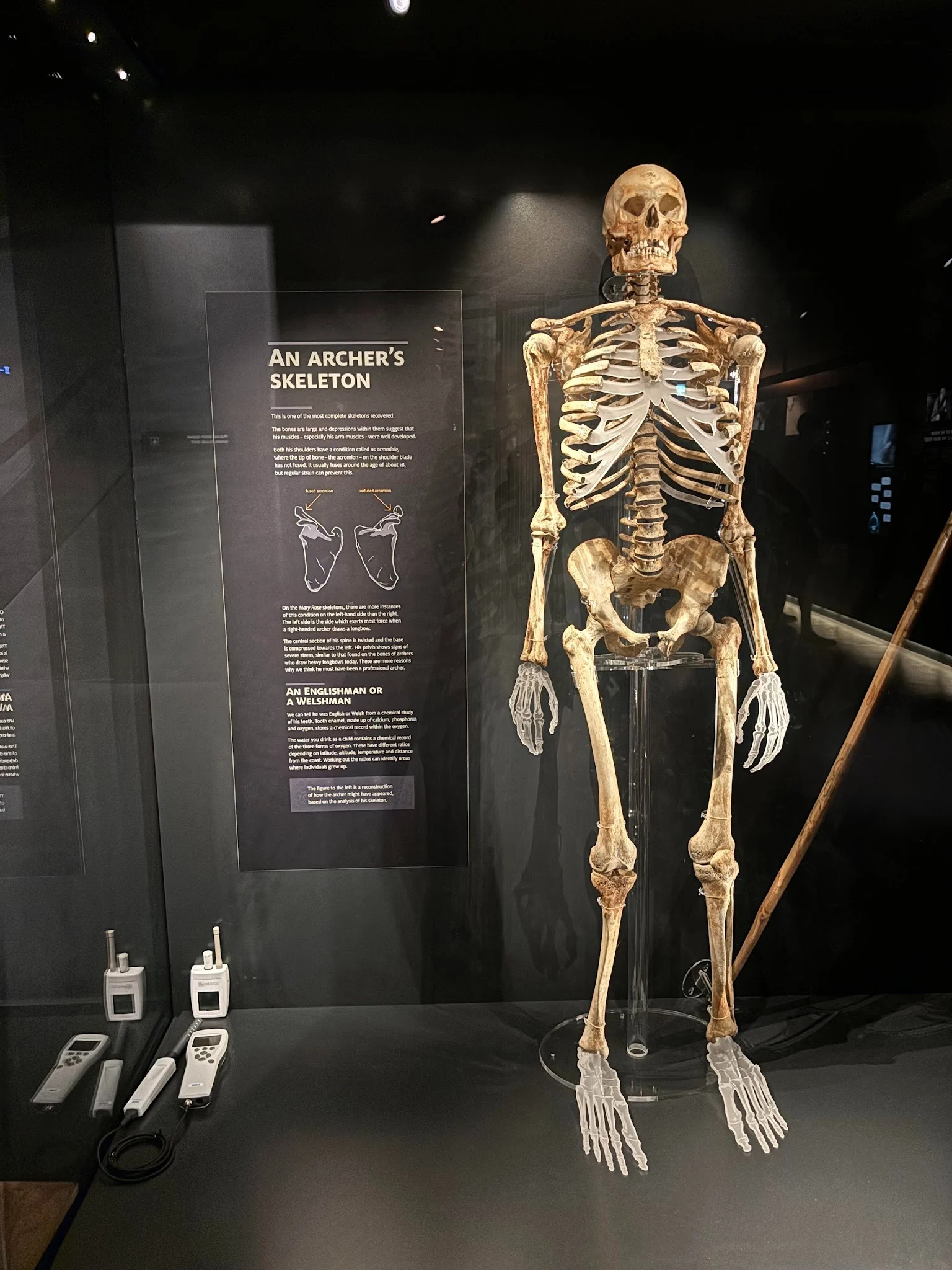
The skeletal remains of archers can show adaptations associated with repeatedly drawing and firing heavily loaded bows.
That’s hardly surprising.
Archery isn’t symmetrical. Each arm performs a different role and experiences different forces.
Repeat that movement thousands upon thousands of times and the body adapts accordingly.
Would we describe those adaptations as an imbalance that needed correcting?
Or were they simply the physical consequences of becoming extremely good at a specific task?
The same principle applies to us today, even if most of us aren’t firing arrows at the French.
Even apparently symmetrical exercises aren’t perfectly symmetrical
Take a squat.
Two feet on the floor. A bar positioned centrally. Down and back up.
It looks symmetrical.
But looking symmetrical and producing force symmetrically aren’t necessarily the same thing.
When people perform movements while standing on force plates — equipment capable of measuring the forces being produced through each side — we can observe differences between the contribution of the left and right legs.
The body is constantly making tiny adjustments.
Your nervous system recruits muscles and distributes forces in whatever way it believes will most effectively complete the task.
Its priority isn’t making the movement look perfectly symmetrical.
Its priority is solving the problem you’ve given it:
Get from here to there.
This is one reason we’re cautious about judging someone’s movement simply by looking at whether everything appears perfectly even.
Usain Bolt: performance doesn’t require perfect symmetry
Perhaps the best modern example is Usain Bolt.
You might imagine the fastest sprinter in history would represent the pinnacle of human symmetry.
He doesn’t.
Bolt has scoliosis and documented asymmetries in his sprinting mechanics. His left and right steps don’t behave identically.
Yet he ran 100 metres in 9.58 seconds.
That doesn’t mean asymmetry improves performance, nor does it mean that asymmetry can never cause problems.
It demonstrates something more important:
High-level human performance doesn’t require perfect symmetry.
Great athletes become incredibly effective at solving movement problems with the bodies they have.
Limb lengths differ. Joint structures differ. Feet differ. Spines differ.
The body finds a solution.
Is it normal to have one leg stronger than the other?
Yes. Some difference between sides is completely normal.
The more useful question is whether that difference is actually affecting you.
If your right leg is slightly stronger than your left but you’re pain-free, strong, active and capable of everything you want to do, simply discovering that difference doesn’t necessarily mean we need to “correct” it.
On the other hand, imagine you’ve recently had a knee replacement and one leg has lost a substantial amount of strength.
Now that difference may be relevant.
Context matters.
At NG Health & Fitness, we’re far more interested in what an asymmetry means for the individual in front of us than whether we can make two numbers perfectly match.
Muscle imbalances after injury or surgery
This becomes particularly important when working with people following injury or surgery.
If you’ve had:
- A knee or hip replacement
- An arthritic joint
- Previous surgery
- A significant injury
- Persistent back or joint pain
- A long period of reduced activity
then expecting your left and right sides to behave identically may not even make sense.
Your anatomy, strength, confidence, range of motion and tolerance to load may genuinely differ between sides.
Trying to force the affected side into exactly the same position as the unaffected side can sometimes make an otherwise useful exercise unnecessarily uncomfortable.
That’s where individualised exercise becomes important.
We fit the exercise to your body — not your body to the exercise
Imagine we’re using a leg press with someone who has an existing knee, hip or ankle problem.
Rather than starting with:
“Your feet must be perfectly symmetrical.”
we start by finding a position that allows that person to comfortably produce force.
Perhaps one foot needs to sit slightly higher.
Perhaps one foot naturally turns out further.
Perhaps the range of movement initially needs to be different.
Perhaps the stronger leg needs to contribute more while we gradually rebuild the capacity of the affected side.
Those aren’t necessarily failures of technique.
They may be exactly what allows that person to train effectively.
From there, we can progressively increase strength, range of motion and tolerance where appropriate.
The goal isn’t to make an exercise look textbook-perfect.
The goal is to create an exercise that works for the person performing it.
When should you worry about an imbalance?
None of this means asymmetries should simply be ignored.
A difference between sides becomes more interesting when it’s associated with something meaningful.
For example, if it:
- Causes or consistently aggravates pain
- Appears following an injury or operation
- Produces significant weakness
- Prevents you performing an activity you value
- Limits your movement or strength
- Changes suddenly without an obvious explanation
then it’s worth investigating.
But that gives us a much better question than simply asking:
“Are my two sides equal?”
Instead, ask:
Does the difference actually matter?
Human beings aren’t perfectly symmetrical.
And we’re probably never going to make you perfectly symmetrical either.
So instead of chasing arbitrary balance between your left and right sides, we want to know:
Does the difference hurt?
Does it prevent you doing something?
Is it limiting your strength?
Is it reducing your confidence?
Is it affecting your quality of life?
If the answer is no, perhaps there’s nothing that needs fixing.
If the answer is yes, then our job isn’t necessarily to make you symmetrical.
It’s to understand why that difference matters to you, find movements and positions your body can tolerate, and progressively build your capacity from there.
A phrase we regularly use in the studio is:
“Pain is not the problem. Pain is the guide.”
Pain gives us information.
We can change the position. Change the range. Change the resistance. Change the exercise.
Then we build from there.
Personal training should accommodate the individual
This principle sits at the heart of how we approach personal training and injury rehabilitation at NG Health & Fitness in Weybridge.
We don’t believe there’s one perfect squat stance, one perfect way to position your feet or a single exercise everybody needs to perform identically.
Before deciding what somebody should do, we want to understand the person we’re actually working with.
Their structure.
Their injury history.
Their current capabilities.
Their goals.
And their response to the exercise in front of them.
Because your body isn’t a building that needs everything perfectly level.
It’s an adaptable biological system.
Let it adapt.
Worried about an injury, persistent joint problem or getting back to exercise?
At NG Health & Fitness in Weybridge, we specialise in individualised personal training for people who want to become stronger, move confidently and continue exercising for decades — including those returning from injury, surgery or physiotherapy.
Rather than forcing you into a predetermined programme, we assess how your body moves and find exercises that work for you.
We don’t try to fit your body to an exercise. We fit the exercise to your body.